Curved Retaining Walls on Slopes in Delaware
Curved retaining walls are often the feature that makes a sloped yard feel intentional instead of awkward. In Delaware and throughout Central Ohio, many properties have elevation changes that require structural support before patios, lawns, or walkways can be installed. While straight retaining walls are common, curved walls introduce additional design and construction challenges that many homeowners do not initially realize.
At Double A Outdoor Living, we design and build engineered retaining wall systems that stabilize slopes and elevate outdoor spaces. If you are researching options for your property in Delaware, Sunbury, or surrounding communities, understanding why curved retaining walls are more complex than straight walls will help you make an informed decision before investing.
Why curved retaining walls are different
A retaining wall’s primary job is structural. It must hold back soil, manage water, and resist movement caused by gravity and freeze thaw cycles. When that wall follows a curve instead of a straight line, the structural dynamics change. A curved retaining wall involves:
-
- Constant layout adjustments to maintain a consistent radius
- Additional cutting or specialized block systems designed for curves
- More precise base preparation to prevent uneven settling
- Careful alignment to maintain smooth visual flow
From a distance, a curved wall may look like a simple design choice. In reality, it requires more planning, more labor, and greater technical skill than a straight installation.
Design considerations for curved walls on slopes
On a flat site, curves are largely aesthetic. On a slope, curves influence how weight is distributed and how drainage is handled. Homeowners often choose curved walls to soften the look of a backyard or to wrap around a patio space, but the engineering must come first.
Key design factors include:
-
- Radius planning – The curve must be consistent to avoid weak points or awkward transitions
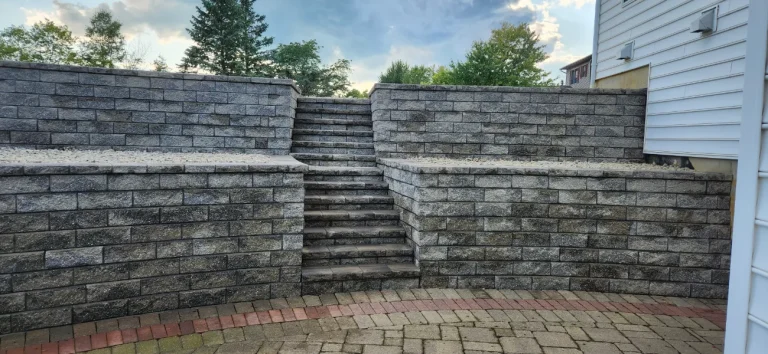
- Wall height variation – Sloped yards often require stepped elevations within the curve
- Soil pressure distribution – Curves can concentrate force differently than straight walls
- Drainage integration – Proper backfill and drainage outlets are critical to long term performance
Before construction begins, we evaluate grading, soil type, and surrounding hardscape features such as paver patios or walkways. This ensures the retaining wall works as part of a cohesive landscape design rather than as an isolated structure.
Material challenges with curved retaining walls
Not all retaining wall block systems are designed to handle tight curves. Some products are better suited for straight runs, while others are engineered with tapered edges that allow for smooth arcs.
As an Authorized Unilock Contractor, Double A Outdoor Living uses premium retaining wall systems that are built to accommodate both straight and curved installations. Even with high quality materials, curved walls require:
-
- More block adjustments to maintain alignment
- Frequent measurement checks to prevent drift in the radius
- Additional base compaction to keep the curve stable
- Precision cutting when tight curves are specified
These added steps increase labor time and require a skilled crew that understands both structural requirements and aesthetic detail. This is one reason curved retaining walls typically cost more than straight installations, a factor clearly outlined in our Hardscape Pricing Guide so homeowners can budget realistically.
Structural complexity on sloped properties
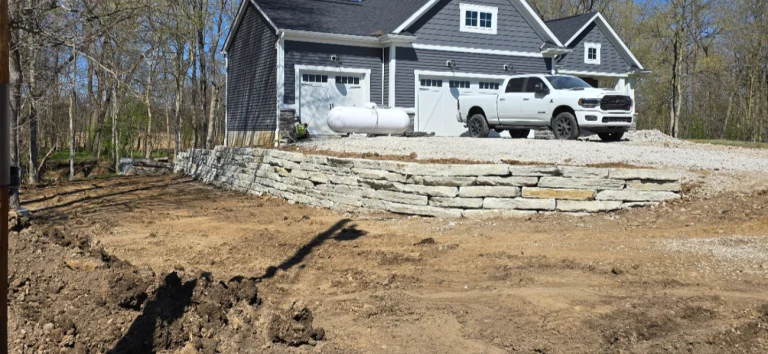
In Delaware and throughout Delaware County, many homes are built on lots with rolling terrain. When a curved retaining wall is installed on a slope, the excavation process becomes more intricate than it would be for a straight wall.
Construction on a slope requires:
-
- Deep excavation to create a level base beneath a changing elevation
- Compacted aggregate base layers that follow the curve precisely
- Reinforcement grids extending back into the soil for added stability
- Integrated drainage systems to relieve hydrostatic pressure
Because curves naturally change direction, any inconsistency in the base can cause long term shifting. Improper compaction or poor drainage can lead to bowing, separation, or wall failure. These are not cosmetic issues, they are structural failures that can affect adjacent patios, lawns, and even foundations.
This level of technical detail is why curved retaining walls are not a suitable DIY project. Structural retaining walls require professional design and installation to meet both safety standards and manufacturer guidelines.
Drainage and water management in curved systems
Water is the leading cause of retaining wall failure. On sloped properties, runoff moves quickly, and if it becomes trapped behind a wall, pressure builds.
With curved walls, drainage planning becomes even more important because:
-
- Water flow paths are less linear than in straight walls
- Multiple elevation changes can create hidden pooling points
- Improper backfill placement can disrupt the intended drainage path
We incorporate gravel backfill, perforated drain pipe, and properly graded outlets that direct water away from the structure. In some projects, we coordinate with our drainage solutions services to ensure the entire yard handles stormwater effectively.
A curved retaining wall must work as part of the overall landscape system. That may include grading adjustments, downspout extensions, or integration with a new lawn or planting plan discussed in our Landscape Pricing Guide.
Comparing curved and straight retaining walls
Both straight and curved retaining walls can perform well when properly installed, but there are important differences:
-
- Layout complexity – Straight walls rely on consistent linear alignment, while curves require constant radius control
- Labor time – Curved walls take longer due to additional measurements and adjustments
- Material waste – Curves may require more cutting and trimming of block
- Visual impact – Curves create softer transitions and can better complement patios and planting beds
- Cost – Curved retaining walls generally have higher installation costs due to labor and material considerations
For homeowners focused purely on function, a straight wall may be sufficient. For those investing in a complete outdoor living space, a curved wall can significantly enhance the visual flow of the yard.
Common homeowner questions
Homeowners in Delaware and nearby communities often ask similar questions when considering a curved retaining wall:
-
- Is a curved wall stronger than a straight wall? Strength depends on design and installation. Both can be structurally sound when engineered correctly.
- Why does a curved wall cost more? Additional labor, layout precision, and material adjustments increase installation time and complexity.
- Can a curved wall be added later? It is best planned as part of a complete hardscape design to ensure proper integration with patios and drainage.
- How long will it last? Professionally installed retaining walls using premium materials can last decades with proper drainage and maintenance.
If your property has significant elevation change, we evaluate whether a single wall or a tiered system will perform better over time.
Case study: reshaping a sloped backyard in Delaware
A homeowner in Delaware contacted Double A Outdoor Living after struggling with an unusable sloped backyard. They wanted a level area for entertaining and a patio that felt integrated into the landscape rather than placed on top of it.
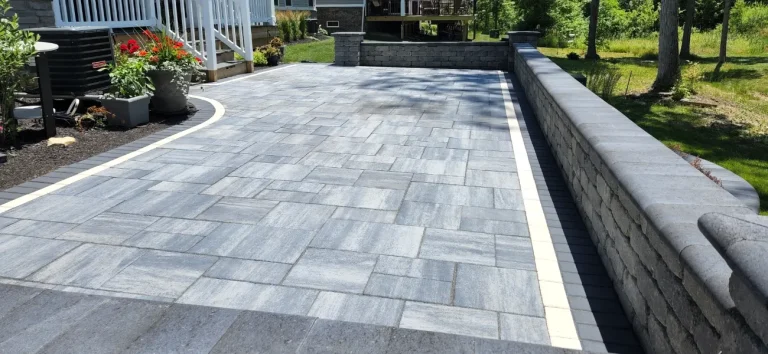
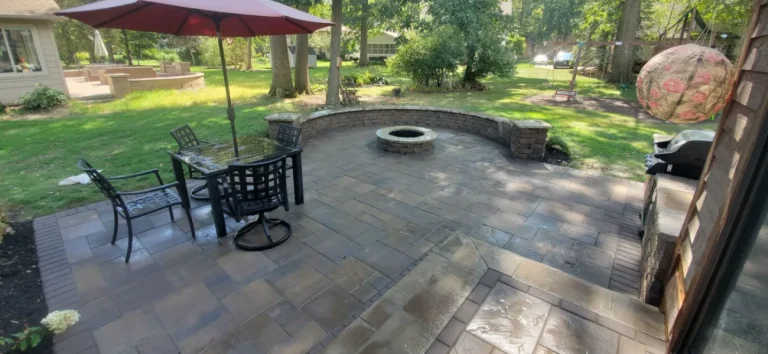
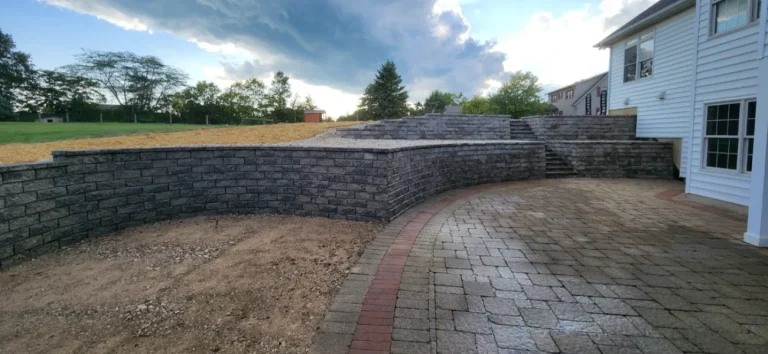
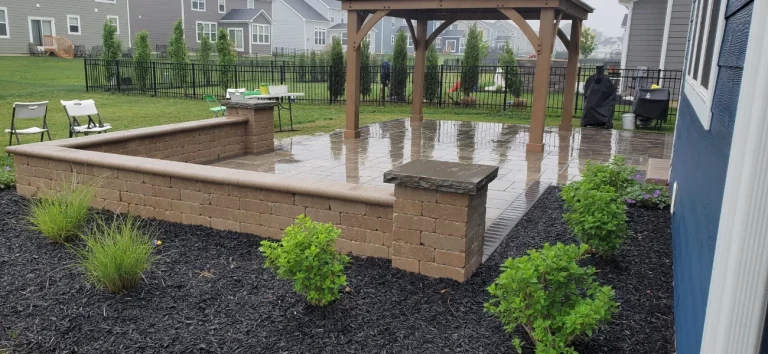
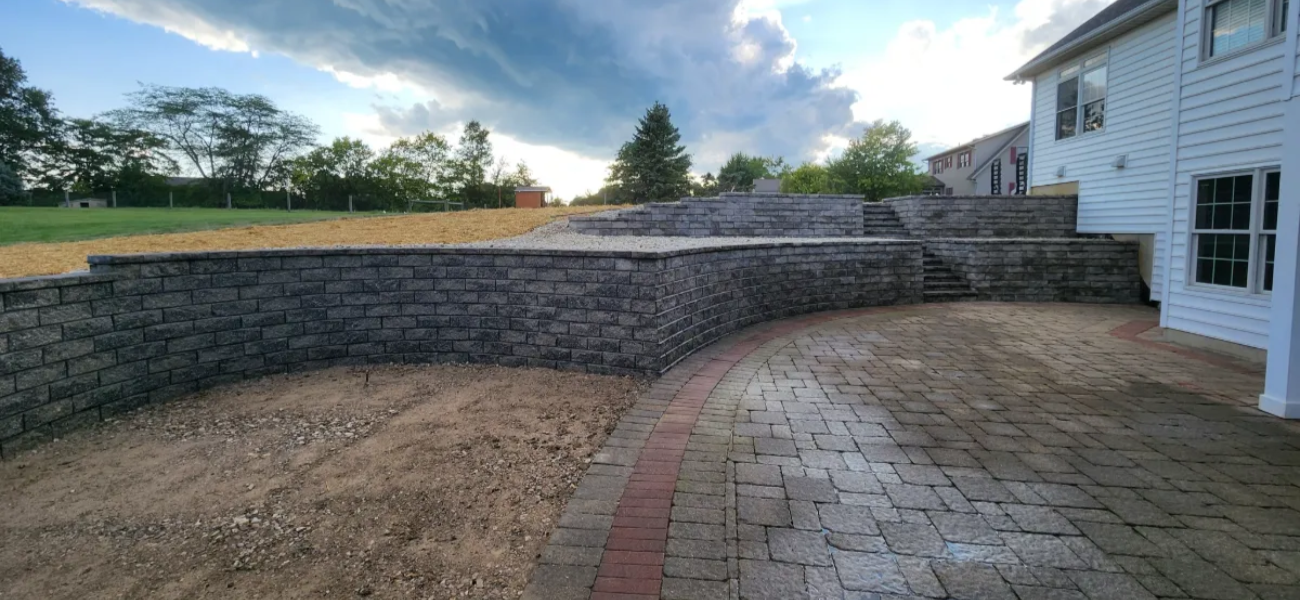
We designed a curved retaining wall that wrapped around the planned paver patio space, creating a defined outdoor room while stabilizing the slope. The curve allowed for smoother transitions between elevations and softened the overall look of the yard.
The project required deep excavation, reinforced backfill, and coordinated drainage improvements. The result was a structurally sound wall that transformed a difficult slope into a functional and visually appealing outdoor living area.
Long term value of professionally built retaining walls
A curved retaining wall is more than a decorative feature. When built correctly, it:
-
- Prevents soil erosion on sloped properties
- Creates usable space for patios, lawns, or gardens
- Protects nearby structures from soil movement
- Enhances curb appeal and overall property value
Attempting to cut costs by hiring inexperienced contractors or attempting a DIY build often leads to premature failure. Repairing a collapsed retaining wall is far more expensive than building it correctly from the start.
Why choose Double A Outdoor Living
Retaining wall construction is one of the most technical aspects of hardscaping. Homeowners across Central Ohio choose Double A Outdoor Living because:
-
- We are a fully licensed and insured landscaping and hardscaping company
- We are an Authorized Unilock Contractor installing premium engineered systems
- Our team has extensive experience with sloped properties in Delaware County
- We provide transparent pricing guidance through our Hardscape and Landscape Pricing Guides
- Our reputation is supported by consistent 5 star reviews for craftsmanship and communication
We approach each retaining wall as both an engineering project and a design feature, ensuring it performs structurally while enhancing your outdoor space.
Serving Central Ohio communities
Double A Outdoor Living proudly designs and builds retaining wall systems and complete hardscape projects in:
As a locally owned company, we understand the soil conditions, drainage challenges, and elevation changes common throughout our region.
Schedule your retaining wall evaluation today
Transform your sloped yard with a professionally engineered curved retaining wall from Double A Outdoor Living
If you are considering a retaining wall in Delaware or surrounding communities, start with a professional evaluation. We will assess your slope, soil conditions, drainage needs, and design goals to determine the right structural solution for your property.
Call Double A Outdoor Living today or request an estimate online to schedule your consultation. Our team proudly serves Central Ohio with expert retaining wall construction, paver patio installation, drainage solutions, and complete outdoor living design.